
Veja: The Sneaker Brand That Grew by Refusing to Advertise
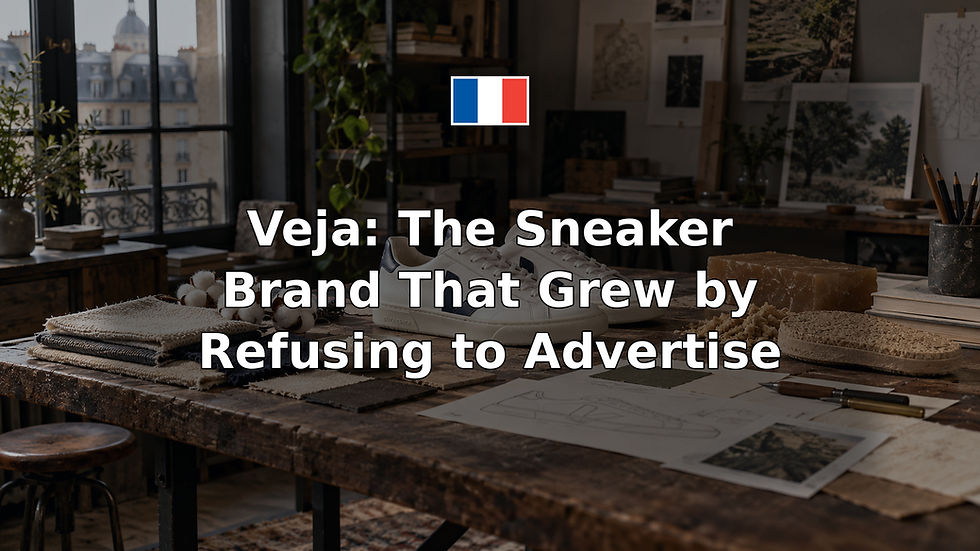
Veja, the French sustainable-sneaker brand founded by Sébastien Kopp and François-Ghislain Morillion, became a cult global name while spending famously close to nothing on advertising — reinvesting the roughly 70% of a typical sneaker budget that normally goes to marketing into better materials and fairer production instead.
The radical bet: spend on the product, not the ads
Veja's founders started from a provocative premise: in a typical trainer, a large share of the cost pays for marketing and athlete endorsements, not the shoe. So they inverted the model. Veja spends famously little on advertising and no money on big sponsorship deals, and pours the savings into organic cotton, wild Amazonian rubber and fair-trade production. The product, in effect, is funded by the advertising budget everyone else spends.
The result defies conventional wisdom: a cult global sneaker brand, worn by celebrities and spotted everywhere, built with almost no paid media. Veja proved you can grow a fashion brand on word of mouth, design and genuine substance — if the substance is real enough to be worth talking about.
Why 'no ads' is a marketing strategy, not the absence of one
Marketing Minute's read is that Veja has not abandoned marketing — it has relocated it into the product and the story. The decision to spend on materials instead of ads is itself the most powerful piece of marketing the brand has: it is a proof point of its values that generates earned media, word of mouth and credibility no ad could buy. 'We put the money into the shoe, not the billboard' is a story people want to tell for you.
This only works under strict conditions. The product has to be genuinely good and genuinely distinctive, and the values have to be real enough to withstand scrutiny. Veja can forgo advertising because it has engineered word of mouth into the product — the design is recognisable, the story is repeatable, and the substance rewards anyone who investigates. Most brands cannot copy this because their product is not different enough to generate its own conversation.
Marketing Minute's read
Veja is not an argument against advertising for everyone — most brands are not distinctive enough to grow without it. But it is a vital reminder that advertising is a substitute for word of mouth, not a replacement for substance. The more remarkable your product and the clearer your values, the less you have to pay to tell people about it. Many brands over-spend on ads precisely to compensate for a product and story that are not interesting enough to spread on their own.
The transferable discipline is to ask, before every media buy: am I paying to amplify something genuinely worth talking about, or paying to compensate for something that isn't? Veja's answer was to make the product so worth talking about that the amplification became almost optional. That is a high bar — and exactly the right one to aim at.
Veja didn't quit marketing — it moved the whole budget into the shoe, and that decision became the best marketing it has. 'We spend on the product, not the billboard' is a story people tell for you. But it only works if the product is genuinely worth the conversation. Ads are a substitute for word of mouth, never for substance. — Daniel Nikolla, Founder of Merx Marketing
Advertising substitutes for word of mouth — it can't replace substance. Make the product remarkable enough to spread, and paid media becomes a choice, not a crutch.
Is your ad budget amplifying something genuinely worth talking about — or quietly compensating for a product that isn't?
If you would like to know more about this topic, please contact us on danieln@merxmarketing.co.uk
Sources: Glossy; Commonshare; Yahoo News. Figures as reported.
Related reading
Written by Daniel Nikolla, Founder of Merx Marketing Ltd and Marketing Minute


