
German Court Forces Berlin Transit to Keep Running Nius Ads
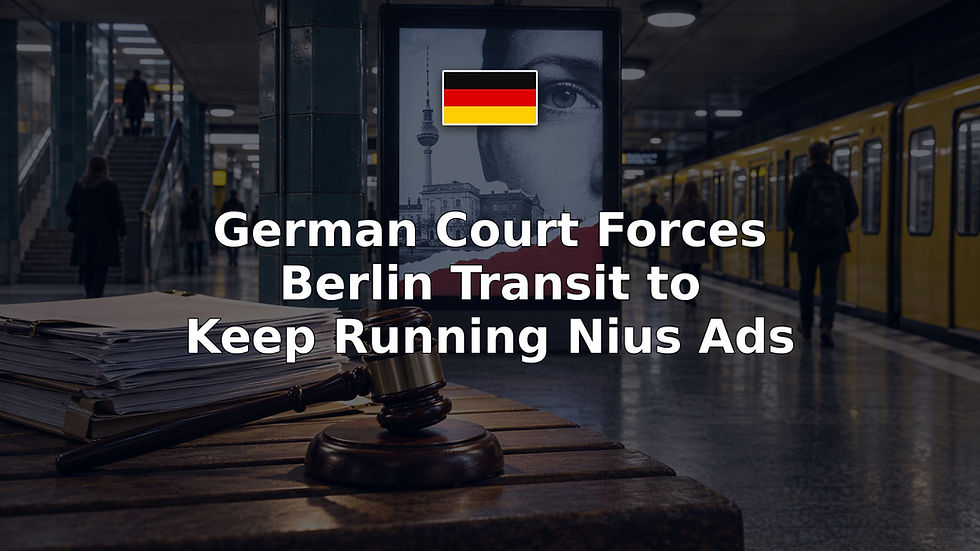
The Higher Administrative Court of Berlin-Brandenburg has ruled that transit operator BVG must keep carrying advertising for the right-wing portal Nius, finding that a public-transport advertiser cannot drop a controversial client over backlash or third-party threats alone — a decision with real implications for out-of-home brand-safety policy.
What the Court Decided
The dispute goes back to spring, when Nius booked a campaign on BVG advertising space. The transit operator approved the ads, which launched in April, then pulled them in early June after public protests and social-media calls to damage transit infrastructure. BVG argued that third-party threats justified ending the advertising relationship.
The Higher Administrative Court (OVG) Berlin-Brandenburg disagreed, and its decision is final. The judges held that Nius has equal, discrimination-free access to advertising space, grounded in freedom of speech and of the press, and that threats from third parties do not justify cancelling a booking.
The court set a high bar: safety concerns only override an advertiser's rights if public order cannot be maintained even with police resources. BVG, it noted, had not involved the police over the threats — a gap that badly weakened its position. In effect, a media owner cannot use public backlash as grounds to refuse a lawful advertiser.
Why This Matters Beyond Berlin
Transit and other public-space media occupy a grey zone between private platforms, which can set their own rules, and public forums, which cannot discriminate between lawful advertisers. This ruling pushes German transit media firmly toward the latter, limiting how much discretion an operator has to reject a paying, legal client.
For media owners, the message is to set acceptance policies in advance, in writing, and on legally defensible grounds — not to improvise under pressure once a campaign draws complaints. Reversing a booking after the fact is exactly what the court refused to sanction here.
The Brand-Safety Lesson for Advertisers
There is a quieter lesson for brands. Brand safety is usually framed as controlling your own message, but adjacency matters just as much — and when a media owner can be legally compelled to carry divisive content, advertisers cannot assume the surrounding environment is curated to their taste.
The practical response is eyes-open planning: understand each media owner's acceptance rules, build adjacency and separation clauses into contracts where possible, and treat public-space media as an environment you share rather than one you control. In a landscape where the courts, not the operator, may decide who appears next to you, that awareness is the safeguard.
Quick FAQ
What did the court rule about Nius ads on the BVG?
The OVG Berlin-Brandenburg ruled, in a final decision, that BVG must keep running the Nius advertising it had earlier approved, because a media owner cannot cancel a lawful advertiser over public backlash or third-party threats alone.
Can a transit operator refuse a controversial advertiser?
Only in narrow circumstances. The court said safety concerns justify exclusion solely if public order cannot be maintained even with police resources — a high threshold that BVG did not meet, having not involved the police.
What does it mean for brand safety in out-of-home?
Advertisers cannot assume public-space environments are curated. It raises the value of clear media-owner acceptance policies and of adjacency awareness when planning transit and OOH campaigns.
This is a brand-safety story hiding inside a free-speech ruling. When a court can compel a media owner to run an ad it would rather refuse, advertisers lose the comfort of assuming the environment is curated. The answer isn't outrage — it's clearer contracts and eyes-open planning for public-space media. — Daniel Nikolla, Founder of Merx Marketing
Brand safety isn't only your own creative — it's your adjacency. When media owners can be legally compelled over who appears on their space, understanding acceptance policies becomes part of the media plan, not an afterthought.
Do you actually know each media owner's advertising acceptance policy — or do you assume the environment is curated for you?
If you would like to know more about this topic, please contact us on danieln@merxmarketing.co.uk
Sources: OVG Berlin-Brandenburg, Meedia, LTO and Tagesspiegel.
Related reading
Written by Daniel Nikolla, Founder of Merx Marketing Ltd and Marketing Minute


Comments