What Aldi and Lidl's Ad War Teaches Every Brand About Selling Value

Germany's discounter ad war — over loyalty apps, freshness crowns and price credibility — is the clearest live masterclass in value marketing: how Aldi, Lidl, Kaufland and the rest sell low prices without ever letting 'cheap' mean 'low quality'.
The most instructive fight in European retail
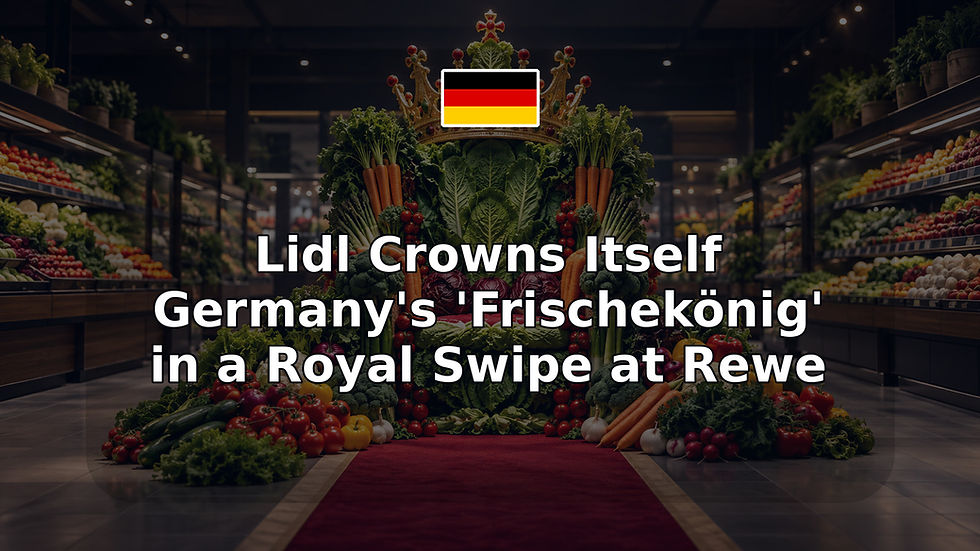
Germany's grocers are staging an unusually open marketing war. Aldi and Lidl are trading blows over loyalty apps and discounts; Lidl has crowned itself the country's 'Frischekönig' — freshness king — in a direct swipe at Rewe; Kaufland has brought in a celebrity face to pick a fight over price with the discounters. On the surface it is retail theatre. Underneath, it is the most advanced value-marketing laboratory in Europe.
Why does it matter beyond Germany? Because value marketing is the hardest marketing to do well. Anyone can shout a low price. The discipline — which German discounters have spent decades perfecting — is to sell low prices while actively building quality perception, so that 'affordable' never collapses into 'nasty'.
The discounter's real trick: price plus pride
The German discounter model works because it never markets on price alone. It pairs aggressive price messaging with relentless signals of quality and trust: award-winning own-label, freshness claims, provenance stories, design-led packaging, and brand campaigns with genuine wit and warmth. The 'Frischekönig' move is pure value marketing — it attacks a rival not on being cheaper but on being better, while the low price sits quietly underneath as table stakes.
Marketing Minute's framework here is simple: durable value brands sell two things at once — a reason to believe it is cheap and a reason to believe it is good. Lead only with cheap and you win the transaction but lose the brand; the moment a cheaper rival appears, you have nothing left. Build quality credibility alongside the price and you earn loyalty that survives a price war.
Borrowing the playbook at any size
You do not need a thousand stores to use this. The transferable moves are concrete. Never let your value message stand alone — always pair it with a proof of quality (a guarantee, an award, a provenance story, visible craft). Attack rivals on what you are better at, not just on being cheaper, as Lidl does with freshness. And invest in the brand even while you compete on price, because the discounter secret is that they spend like premium brands on marketing precisely so their low prices feel like a smart choice rather than a compromise.
For a German or any SME squeezed between cheap imports and premium incumbents, this is the escape route from the race to the bottom. 'Affordable and genuinely good, and here's the proof' is a far stronger position than 'cheapest' — because cheapest is a title someone can always take from you tomorrow.
The genius of the German discounters is that they never actually sell on price. They sell quality you can trust and let the low price sit underneath as a given. 'Cheapest' is a crown anyone can steal next week. 'Affordable and genuinely good' is a position you get to keep. — Daniel Nikolla, Founder of Merx Marketing
Never market value on price alone. Pair every price message with hard proof of quality — that's how discounters make 'cheap' mean 'smart', not 'nasty'.
When you talk about being affordable, do you also give customers a concrete reason to believe you're good?
If you would like to know more about this topic, please contact us on danieln@merxmarketing.co.uk
Sources: HORIZONT; Lebensmittel Zeitung; Marketing Minute analysis.
Related reading
Written by Daniel Nikolla, Founder of Merx Marketing Ltd and Marketing Minute